Fused mxfp4 quantization & matmul kernel on the
AMD MI355X
averne
April 2026
Introduction
I participated in the first phase of the AMDGPU
MODE contest. The goal was, essentially, to beat the AITER kernels on three tasks:
mxfp4 matmul, MoE, and MLA.
In this post, I want to go over what I learned and the techniques and
tricks I used. I will first explain my approach to in-kernel bf16
mxfp4 quantization, then build a hardware-accelerated matmul loop using
AMD’s Matrix Cores. From there, I will progressively improve it with
more advanced techniques (block remapping, direct global-to-LDS loads,
swizzling, double buffering) and shape-specific specializations
(split-K, blocked kernels). Finally, I will briefly review the winning
entries to see what I was missing.
This post assumes some degree of familiarity with GPU programming
concepts and terminology (especially
AMD’s),Modal’s
GPU glossary is a useful
resource to map NVIDIA/AMD terms. floating-point arithmetic, and
matrix
multiplication.You
can check out the excellent blogs by Simon Boehm, Sebastien
Vince, or the recent one by AMD’s
own AI team.
Quantization
The A matrix is given in K-major bf16 format, so it must be quantized
to mxfp4 before being fed to the matrix cores.
The mxfp4 format
First, let’s go over mxfp4: it is a microscaled 4-bit floating-point
format specified by the Open Compute
Project.If
you’re interested, you can find the spec here.
It essentially packs values in groups (“blocks”) of 32 and assigns each
group a shared scale value. For mxfp4, this scale is basically the
standalone exponent field of an fp32 value, with the same bit width (8)
and bias (127).
During conversion to mxfp4 (i.e. quantization), a block of 32 values
is considered. It is normalized by its magnitude: the values are then
encoded in 4 bits, while the normalization factor becomes the
scale.
This separate scale value allows mxfp4 to retain a range equal to the
common fp32
typeTechnically,
the achievable range is even greater since the exponent is the same bit
width as fp32, and the fp4 part can go beyond 1.0. But the OCP only
specs for the fp32 range, and the remainder is
implementation-defined. while enabling extreme compression.
Because of the normalization process, this works especially well when
the original values have a low dynamic range; otherwise, smaller values
may be rounded to 0.
Figure
1: The mxfp4 floating-point format
Each 4-bit element uses the e2m1 encoding: 1 sign bit
,
2 exponent bits
,
and 1 mantissa bit
,
with exponent bias 1. The decoded element value
is:
The only representable values are therefore:
Bits
Kind
Value
S'00'0
zero
S'00'1
subnormal
S'01'0
normal
S'01'1
normal
S'10'0
normal
S'10'1
normal
S'11'0
normal
S'11'1
normal
The scale
is encoded in the e8m0 format. It is floating-point only in name: in
practice, it is closer to a uint8, since it is essentially the exponent
field of an fp32 value. It is added to the exponent of the fp4 value to
reconstruct the final number
:This
expression is only valid for normal numbers.
Hardware-assisted quantization
The MI355X includes a convenient instruction that does the hard part
of the job: v_cvt_scalef32_pk_fp4_bf16. It takes two bf16
values together with the scale in fp32 format and performs the scaling
and packing into a
byte.The
operation can be repeated until all four bytes of a 32-bit register are
filled (the instruction can encode a selector for the destination
byte).
So our task is just to find the scale
for the block and run this instruction 16 times.
For a block
,
the OCP conversion rule chooses
as the largest power-of-two less than or equal to
,
divided by the largest power-of-two representable in fp4, i.e.
:
Finding the block magnitude
First, we need to take the absolute value of the bf16 input. The
MI355X does not feature a dedicated abs instruction, so we
must do it manually by clearing the sign bit (AND with
0x7fff7fff).This
is also the approach taken by the HIP runtime function
__habs2, see godbolt.
Now, we need to find the maximum value in the block. This is our
first real hurdle: the MI355X does not have a bf16 max/max3 instruction,
unlike for fp16 and fp32. And indeed, using __hmax2
produces an absolute disaster in codegen (see godbolt).
So we are left with two options: (1) convert to fp32 and find the
maximum,The
fp32 version is slightly better but still far from optimal (see godbolt). or (2)
think harder about it.
Floating-point formats have a fairly well-known property: the next
representable value after a number is the same bit pattern with 1 added
to it as if it were a signed
integer.This
assumes positive values only (remember we just applied abs
on the whole block). An interesting corollary is that
floating-point formats are ordered under their bitwise
representation.This
blog
makes a nice use of this property. This means that we can take
the bf16 values, alias them to fp16, and use the native maximum
instructions!
Of course, this is not a strictly valid comparison. If the input bf16
value is too large, its exponent would fill the entire fp16 exponent
field with 1s after aliasing, which is a NaN/inf. However, the input
data is generated with PyTorch’s randn, which follows a
Gaussian distribution with
and
,
so the probability of hitting this edge case is negligible.
In fact, the MI355X provides a very nice instruction:
v_pk_maximum3_f16: this takes three fp16 pairs and performs
eight comparisons at once, giving us the element-wise maximum. LLVM
doesn’t emit this instruction and doesn’t have a builtin/intrinsic for
it, so we have to use inline assembly.
With all these tricks put together, we reduced the instruction count by
more than
25
compared with the first version using __hmax2! (from
to
)
Calculating the
scale
We now have the block magnitude
,
and we must derive the scale from it using
.
Let’s remember a few things.
First, the exponent of a floating-point number
essentially encodes
.
Moreover, the bf16 and e8m0 formats have the same exponent bias (127).
This means we can extract the exponent of the magnitude in bf16 format,
store it in a byte, and the only remaining step is the division by 4.
Since the exponents are already in the log domain, division by 4 becomes
subtraction by
.
So in the end, calculating the scale reduces to just two integer
operations: a shift by 7 (extracting the bf16
exponent)Remember
that we are dealing with positive values, so the sign bit is cleared and
we don’t need to care about it. But even if it weren’t, we could use the
bitfield extract instruction (v_bfe_u32) and keep things
just as compact. and a subtraction by 2.
Note that this approach is not valid for subnormals or zero. But again,
due to the input distribution, encountering one as the magnitude of the
block is statistically near-impossible.
Finally, one last step: v_cvt_scalef32_pk_fp4_bf16
expects the scale in fp32 format, not e8m0. But converting to that is
easy: since fp32 again has the same exponent bias, we can just shift the
e8m0 value into the exponent field of the fp32.
And now we just have to use the conversion instruction. Below is my
quantization routine (check the codegen on godbolt).
Note that the scale calculation first adds an offset of 32 to the
mantissa. This is off-spec, but it matches the AITER
quantization kernel.
Now that we have an efficient quantization routine, let’s take a
closer look at the matrix multiplication itself. In particular, we will
use matrix cores (AMD’s answer to NVIDIA’s tensor cores) to accelerate
the tiled computation.
An important part is that the input shapes are fixed, which will
allow us to come up with specialized approaches later.
M
N
K
4
2880
512
16
2112
7168
32
4096
512
32
2880
512
64
7168
2048
256
3072
1536
The small M sizes, relative to the other dimensions, call for
dedicated approaches in particular, as we will see later.
Matrix core layouts
The input B matrix is already given in mxfp4 format, so we naturally
want to use the MI355X’s support for low-precision datatypes. In
particular, two instructions are available:
v_mfma_scale_f32_16x16x128_f8f6f4 and
v_mfma_scale_f32_32x32x64_f8f6f4. The host code strongly
steers us toward the former, because it shuffles the B weights in
-row
blocks to match that instruction’s hardware register layout.
MFMA operations require wave-level cooperation: each lane holds its
share of the A, B, and C weights, along with the corresponding scales.
The exact layout is specified in the CDNA4 ISA
manual.You
can find it here.
The layouts for v_mfma_scale_f32_16x16x128_f8f6f4 are in
sections “7.1.5.1. Dense Matrix Layouts: 8-bit and Smaller” for the
weights, and “7.2.1. MFMA with Block Exponent Scaling” for the
scales.
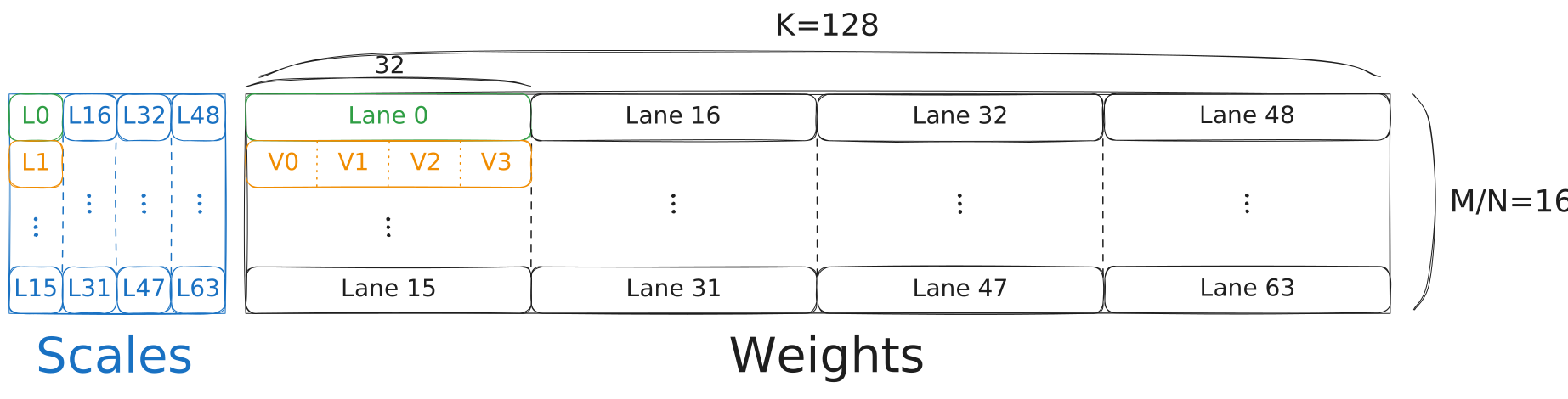
The input A and B matrices are laid out column-major with respect to
the lane index. Each lane holds 32 values (one mxfp4 block), packed into
four 32-bit registers, corresponding to 32 columns along the K
dimension. Figure
2: Weights/scales register layout for the A/B input matrices, with
v_mfma_scale_f32_16x16x128_f8f6f4
The host code shuffles the prequantized B matrix to match this
layout. In effect, it breaks the matrix into
subtiles,The
python snippet uses 16-by-16, because PyTorch treats the data as fp4x2
(basically, addressing bytes), so that 16 elements are actually 32 fp4
values. then swaps the axes so that the weights within each 2D
tile become contiguous in memory.
This shuffling lets us read an entire
B tile with a single instruction (e.g.
global_load_dwordx4).
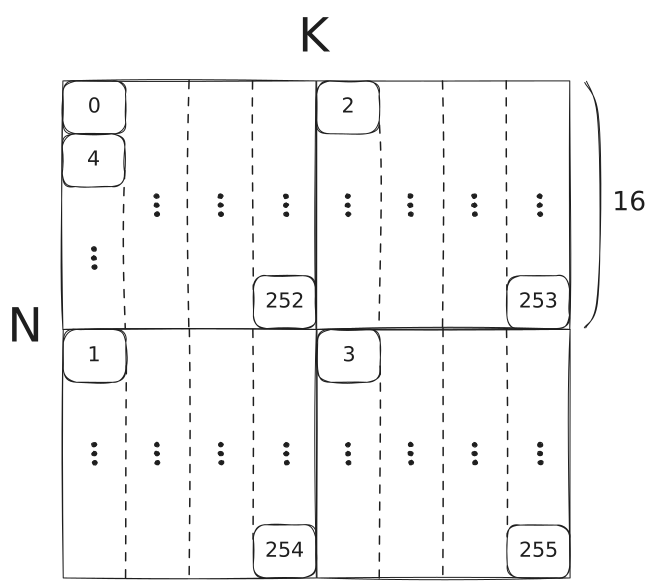
The B scales are also shuffled, but with one extra complication: the
host code packs them into a
MFMA supertile (i.e.
in total), so four consecutive e8m0 values actually belong to different
tiles.
Below is a little visualization of this shuffling. The point is that,
with a single load instruction, a wave can fetch the scales for four
closely related tiles and perform eight MFMAs to produce an output
supertile. This increases the arithmetic intensity of AITER’s matmul
kernel, since it does more work for the same data movement. However, it
also greatly complicates address calculations for code that does not
follow the same scheme (as I found out the hard way).
Figure
3: Shuffled B-scale layout
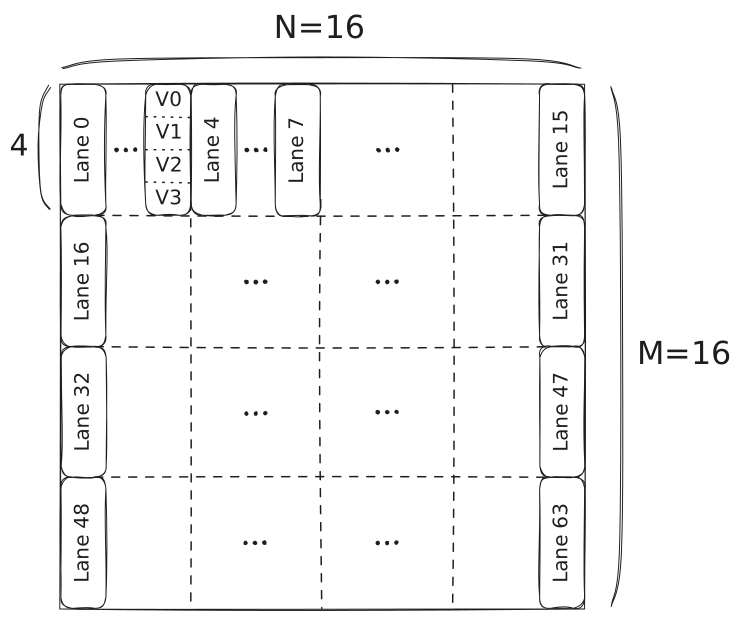
On the other hand, the output/accumulation C matrix is laid out
row-major, with each lane holding four fp32 values in four separate
registers: Figure
4: Weights register layout for the C output matrix, with
v_mfma_scale_f32_16x16x128_f8f6f4
This discrepancy between input and output layouts is one of the
quirks of AMD matrix cores. By contrast, NVIDIA builds its layouts from
a
“core matrix” (see fig. 3a in this paper).
A basic matmul
kernel
Now that we understand the register layout and the input
pre-shuffling, we have all the pieces in place to build a simple first
matmul kernel.
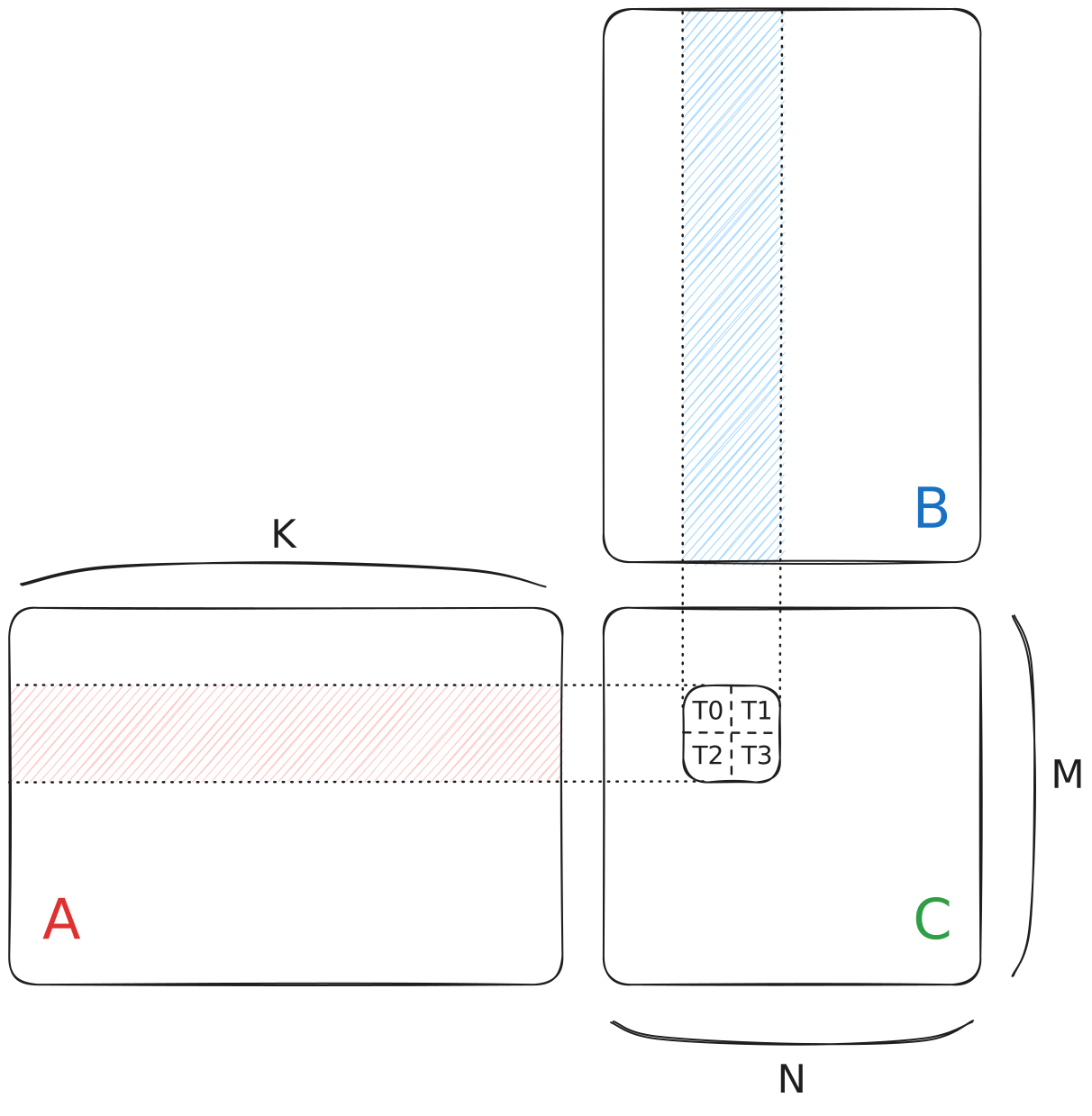
To keep things simple, we will divide the output into
tiles (the shape of the matrix core instruction), and assign a separate
block to each one, consisting of a single full wavefront (64 threads).
The kernel then walks the K dimension in steps of 128 (the size
processed by each MFMA instruction), quantizes the A tile, accumulates
the C tile into registers, then finally writes out the results to global
memory.
__global__ __launch_bounds__(64)__attribute__((amdgpu_waves_per_eu(2, 2)))void kern_mm(bf16 *C_ptr,const bf16 *A_ptr,const fp4x32 *B_ptr,const fp8e8m0 *Bs_ptr, u32 m, u32 n, u32 k){// Inform the compiler about problem shapes (removes some pessimistic branches)__builtin_assume(m >=4&& n >=2112&& k >=512&&(m &3)==0&&(k &511)==0);auto tid = threadIdx.x, lid = tid &63;auto C_tile_x = blockIdx.x, C_tile_y = blockIdx.y, C_x = C_tile_x * mxc_tile_y, C_y = C_tile_y * mxc_tile_y;// Iterate through the K dimension fp32x4 C ={};for(u32 it =0; it < k; it += mxc_tile_x){auto*ptr =reinterpret_cast<const AliasedBlockBf16 *>(A_ptr +(C_y +(lid &15))* k + it +(lid >>4)*32);auto A =*ptr;// Hint the compiler to schedule the Bq loads after A, only allow// ALU instruction to move across this boundary__builtin_amdgcn_sched_barrier(1);auto Bq = alias(AliasedBlockFp4, B_ptr[(C_tile_x * k + it)/ mxc_tile_x *64+ lid]);auto Bs = Bs_ptr[(C_tile_x /2* k / mxc_tile_x /2+ it / mxc_tile_x /2)*64*4+ lid *4+((it / mxc_tile_x &1)*2)+(C_tile_x &1)];auto[Aq, As]= quantize_block_mxfp4(A);// The intrinsic requires 8 dwords for the A/B matrices, // because it has to support the fp8 version,// but the compiler will eliminate unused top 4 dwords. C =__builtin_amdgcn_mfma_scale_f32_16x16x128_f8f6f4( u32x8{Aq.u32[0], Aq.u32[1], Aq.u32[2], Aq.u32[3]}, u32x8{Bq.u32[0], Bq.u32[1], Bq.u32[2], Bq.u32[3]}, C,4,4,// A/B dtype selection (fp4)0, As,// A block scale opsel + value0, Bs);// B block scale opsel + value}// Write the C tile into global memory using nontemporal stores,// to avoid evicting useful data from the caches.if(C_y +(lid >>4)*4< m){for(u32 i =0; i <4;++i)__builtin_nontemporal_store(static_cast<bf16>(C[i]), C_ptr +(C_y +(lid >>4)*4+ i)* n + C_x +(lid &15));}}
Already, a few things are worth noting:
Two compiler hints to improve codegen:
One on the input constraints, which removes an early check on K to
see whether it is non-zero (which is always true for our shapes).
Another on the loading, to force it to separate A and B reads. This
way, the code can wait on B/B-scales to arrive only after quantization
is finished.
We use nontemporal stores on the output, since this data will not be
reused and does not benefit from caching. It helps reduce cache pressure
and keep useful data around.
We force the compiler to use vector registers (VGPRs) instead of
accumulator registers (AGPRs) for the MFMA with
-mllvm=--amdgpu-mfma-vgpr-form=1, which removes a few data
movement instructions (v_accvgpr_{read,write}_b32). In my
experience, this is redundant with the amdgpu_waves_per_eu
attribute since LLVM will prioritize VGPRs when it knows only few waves
will be resident (and thus it can use many VGPRs), but I prefer to make
certain.
Block remapping and tile assignment
The MI355X has a stacked chiplet architecture, meaning that the card
is made up of several chips fabricated separately, and later assembled
into a single card. In particular, it separates compute and I/O dies:
the former (XCDs) comprise the CUs and L2 cache, and the latter (IODs)
hold the coherency units, L3 cache (aka. infinity cache), the memory
controllers, etc. The 8 XCDs are physically bonded to the 2 IODs (4 XCDs
per IOD) via a direct copper-to-copper process, and the two IODs are
themselves placed on a passive silicon substrate that enables die-to-die
communication through physical interfaces
(PHYs).Check
this paper
for an excellent exploration of the fabrication/design processes
involved.
The critical part is that each XCD has its own private L2 cache, so
we want to make sure that blocks resident on the same XCD are operating
on related data, to maximize reuse and minimize cache pressure. However,
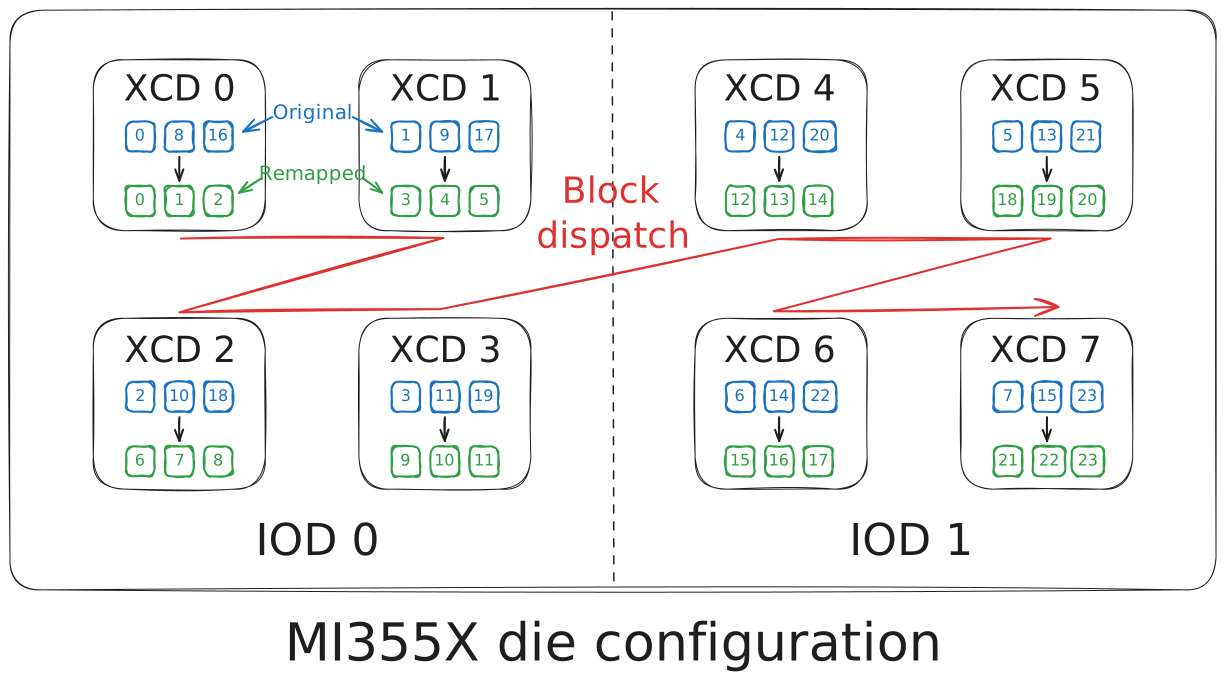
blocks are dispatched in a round-robin manner across XCDs, such that
consecutive blocks are actually physically located on different compute
(and even sometimes I/O) dies.
Thus, we want to “remap” the block ID so that consecutive blocks end up
on the same XCD.
Figure
5: Compute and I/O chiplet configuration for the MI355X, and
vanilla/remapped block IDs for a 24-wide dispatch
Basically, what we want to do is move the 3 LSBs of the block ID,
which represent the XCD ID, to become the MSBs of the remapped block ID
(so essentially, a 3-bit right-rotate). For a variable grid size
gsz, the remapped block ID rbid can be
calculated from the original bid with this expression:
rbid =(bid &7)*(gsz >>3)+(bid >>3);
On top of that, we want to assign spatially nearby output tiles to
blocks on the same XCD. This way, the portions of the A and B matrices
can be held in the L2 and reused across different CUs:
Figure
6: Tile assignment for improved cache reuse.
Here we would assign 4 CUs on the same XCD to process tiles 0 to 3, and
benefit from the reuse of rows/columns of A/B,
respectively.
Since our input shapes are known and have a relatively small M, we
can just assign consecutive blocks to the same column of the C matrix.
The output tile indices can therefore be calculated from the remapped
block index with:
C_tile_x = rbid / tm, C_tile_y = rbid % tm;
with tm the number of 16-high tiles in the C matrix
(i.e. M / 16). In addition, since M is always
a power of 2, we can optimize the expensive integer division and modulo
operationsThe
MI355X has no instruction-level support for these operations on
integers, so it will convert back and forth between integers and fp32
(see godbolt, note the
v_cvt_* conversion instructions). On the other hand, there
is a CTZ instruction (v_ffbl_b32). with:
At this point, our access pattern for loading A is pretty
inefficient: since we need each lane to hold a block of 32 weights, we
are issuing 4 global_load_dwordx4 instructions. However,
the addresses are disjoint, leading to poor coalescing and emitting more
load requests than necessary. Instead, we would like to load 4 rows of
the A tile per instruction, then shuffle the data into the correct
locations.
For this, we can use LDS: the weights are first loaded to shared
memory using coalesced accesses, then each lane reads the data it needs
from fast local memory.
In particular, we use direct global-to-LDS loads, bypassing an
intermediate step in registers. This is done via the
buffer_load_dwordx4 instruction. The code looks like
this:
// Build buffer descriptor for A// We disable exceptions (user_vm_mode = 0), since the code will issue OOB loads for M < 16auto A_rsrc =__builtin_amdgcn_make_buffer_rsrc(reinterpret_cast<void*>(A_ptr),0, m * k *sizeof(*A_ptr),0x10000);// LDS storage for a single A tile, used for loading/shuffling into VGPRs__shared__ AliasedBlockBf16 A_lds[mxc_tile_x*mxc_tile_y/mxc_qblock_sz];for(u32 it =0; it < k; it += mxc_tile_x){// Load A tile into LDS// We need (128*16*2) / (64*16) = 4 requests per tile, each loading 4 rows in the M dimensionauto A_voff =(lid >>4)* k +(lid &15)*8, A_soff = C_y * k + it, A_incr =4* k;for(u32 i =0; i <4;++i){__builtin_amdgcn_raw_ptr_buffer_load_lds( A_rsrc,static_cast<void*>(A_lds + i *16),16,// Load sizestatic_cast<u32>( A_voff *sizeof(bf16)),// Global offset (via VGPR)static_cast<u32>((A_soff + i * A_incr)*sizeof(bf16)),// Global offset (via SGPR)0,// Global offset (via immediate)0);// Cache policy flags}// Load B/B-scale...// Shuffle A from LDS into registersauto A = A_lds[(lid &15)*4+(lid >>4)];// Quantize A + perform MFMA...}// Epilogue...
One small optimization is achieved via the buffer descriptor: we
instruct the hardware to not emit faults when accessing out-of-bounds
data, and instead return zeroes. This is useful when M is smaller than
16: we can remove a bounds check in the loading code, and the invalid
requests will “complete” immediately, additionally clearing the
uninitialized LDS.
Resolving bank conflicts with swizzling
The code above has an issue: it accesses LDS with a stride of 64B (32
bf16 elements) during the readout of A from
LDS.It
might not look like it from the code but keep in mind the size of each
AliasedBlockBf16 is 64B, and the compiler has to break down
the load into 4 ds_read_b128 instructions, hence the bank
conflict issue. This is problematic, because it creates LDS bank
conflicts.
The LDS block on the MI355X is made up of 64 independent banks each
containing 640 dwords (i.e. 160 KiB in total). Additionally, LDS
accesses are performed in phases: if more than one address maps to the
same bank during the same phase, then the accesses must be serialized,
hence creating a conflict and requiring additional time to complete.
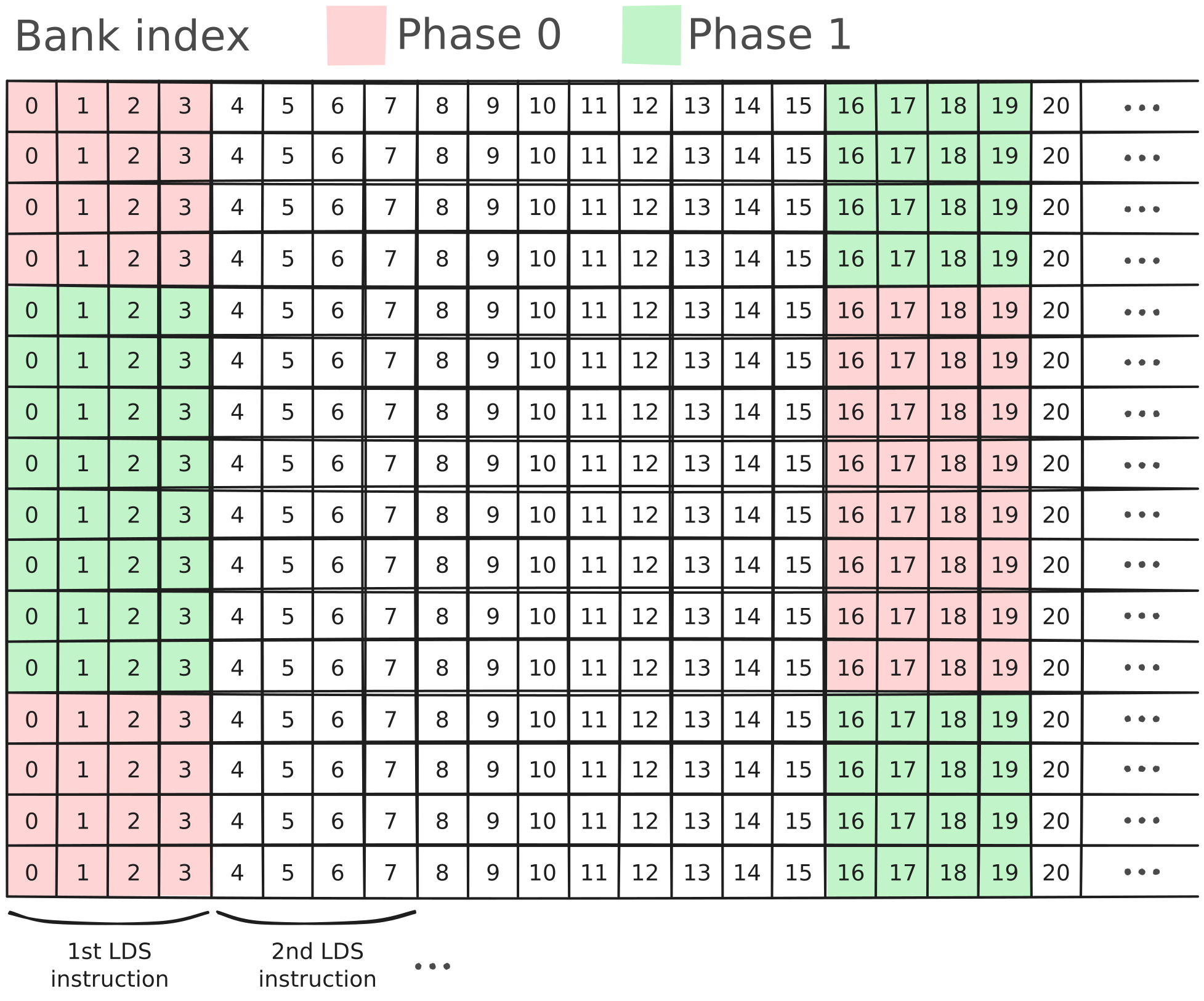
The phase pattern for ds_read_b128 is documented here.
If we superimpose it with our LDS layout for the A tile, the bank
conflicts become obvious: Figure
7: LDS layout for the A tile in bf16 format, without
swizzling
In the figure above, each square represents a bank element (32 bits),
which contains 2 bf16 values. The MFMA tile K-size (128 bf16) matches
perfectly the number of banks, such that one row of the A tile engages
all 64 banks. This also means that each column of the tile is stored in
the same bank. 4 ds_read_b128 instructions are necessary to
complete the load from LDS, each reading 16 columns.
The problem arises because lanes try to read columns of A: we have an
8-way bank conflict, as 8 lanes per phase try to access the same
bank.
Since we have the same number of lanes and banks (64), we must
somehow spread out the accesses so that one bank is activated exactly
once per phase. At the same time, we need to keep groups of 8 bf16
elements consecutive (i.e. 16 bytes), because of the MFMA register
layout. Therefore, the lowest
bits of the LDS load address will remain untouched.
Looking again at the phase pattern, we notice the accesses are done
in “squares” of
,
so the first step is to make these squares access different banks. To
achieve this, we need to modify the
bits after the 4 LSBs, i.e. the 4th and 5th. We would like them to
change values when reaching another row, which is controlled by the
th
bit onwards. So putting this together, we need to XOR the 4th and 5th
bits with the 8th and 9th: swizzled =((addr >>4)&(0b11<<4))^ addr.
This doesn’t fix everything, though: pairs of “squares” are still
accessing the same banks. We have improved to a 2-way bank conflict, but
there is still one step to go. Currently we are engaging banks 0-15 and
16-31 (each twice per phase), so we need to get banks 32-63 into the
mix. Following the same reasoning as before, we switch the value of the
th
bit when we reach another group of 4 rows, i.e. when the
th
bit is activated. With this, the final swizzling expression becomes:
auto swiz =[](u32 addr){return(((addr >>4)&(0b11<<4))|((addr >>3)&(0b1<<7)))^ addr;};
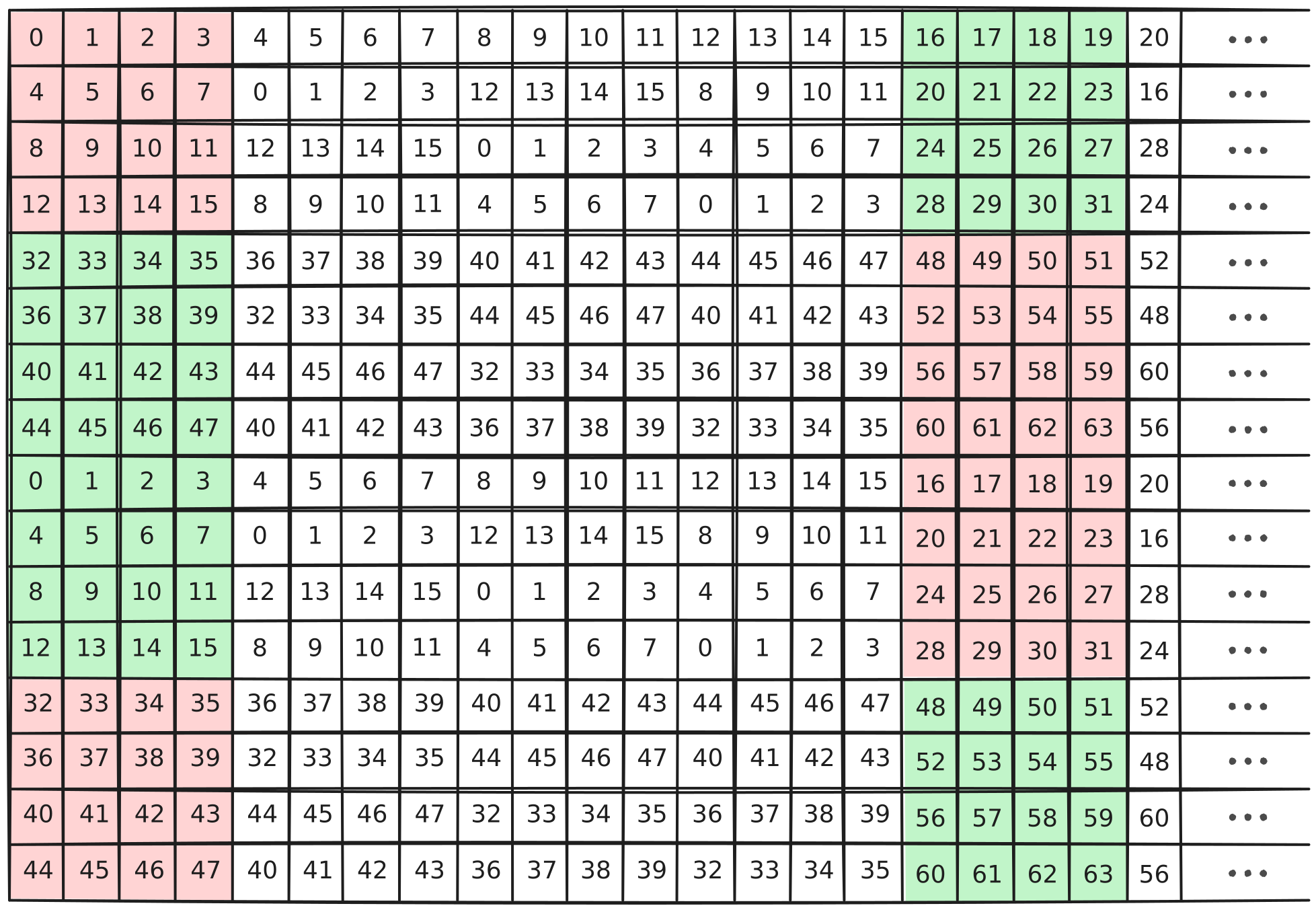
The swizzled LDS layout looks like this: Figure
8: LDS layout for the A tile in bf16 format, with
swizzling
Notice how phases access each bank exactly once. Since XOR is
involutive (i.e. A ^ B ^ A = B),
and the transform does not modify bits which are later used as input, we
can use this same swizzling pattern when loading into LDS and reading
results back to registers.
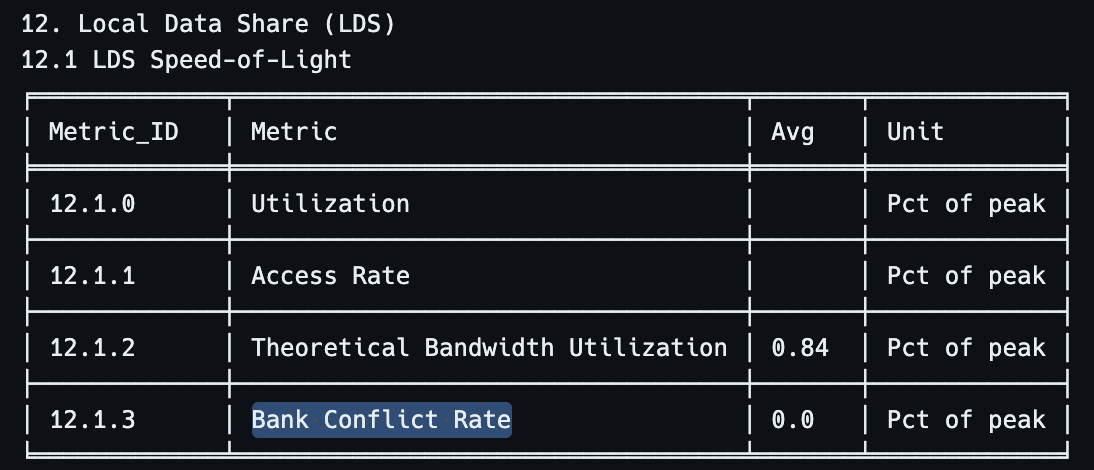
To make sure bank conflicts are fixed, we can check in
rocprof-compute: Figure
9: Bank conflict rate in the kernel, after swizzling
Double-buffering
With the addition of global-to-LDS loads, we are just one step away
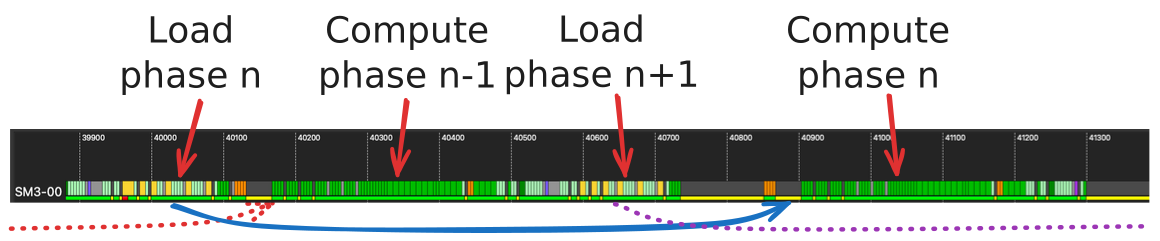
from achieving better compute/memory overlap. Indeed, at the moment we
are processing these two operations serially: a wave first loads A/B
tile data, then performs quantization and MFMA. For the entire duration
of the load, the wave is idling, as can be seen in the trace below.
Figure
10: Hardware trace of a loading/compute phase with serial
loading
The idea of double buffering is simple: using LDS as a staging
buffer, we initially perform a load operation (i.e. load an A/B tile
pair), then ping-pong between load and compute until completion. Since
the compute operation processes data that was loaded in the previous
phase, it overlaps with the next load. Essentially, we are pipelining
loading and compute.
In code, it looks like this:
// LDS staging buffers__shared__ bf16x8 A_lds [2][mxc_tile_x*mxc_tile_y/8];__shared__ fp4x32 Bq_lds[2][mxc_tile_x*mxc_tile_y/32];__shared__ fp8e8m0 Bs_lds[2][mxc_tile_x*mxc_tile_y/32*4];auto load_to_lds =[&](u32 it, u32 phase)__attribute__((always_inline)){// Issue buffer loads for A weights, and B weights/scales...};auto do_compute =[&]<int outstanding>(fp32x4 &C_dat, u32 it, u32 prev_phase, C<outstanding>)__attribute__((always_inline)){__builtin_amdgcn_s_waitcnt(0xf70| outstanding);// Read A from LDS, quantize to mxfp4auto A_dat = AliasedBlockBf16{};for(u32 i =0; i <4;++i){auto idx =((lid &15)*4+(lid >>4))*4+ i; A_dat.x8[i]= A_lds[prev_phase][idx ^ swiz(idx)];}auto[Aq_dat, As]= quantize_block_mxfp4(A_dat);__builtin_amdgcn_s_waitcnt(0xf70|(outstanding -2));// Read B weights/scales from LDSauto Bs_dat =reinterpret_cast<u32 *>(Bs_lds[prev_phase])[lid]; Bs_dat >>=((C_tile_x &1)+(it / mxc_tile_x &1)*2)*8;auto Bq_dat = alias(AliasedBlockFp4, Bq_lds[prev_phase][lid]);// Accumulate C_dat =__builtin_amdgcn_mfma_scale_f32_16x16x128_f8f6f4( u32x8{Aq_dat.u32[0], Aq_dat.u32[1], Aq_dat.u32[2], Aq_dat.u32[3]}, u32x8{Bq_dat.u32[0], Bq_dat.u32[1], Bq_dat.u32[2], Bq_dat.u32[3]}, C_dat,4,4,0, As,0, Bs_dat);};// Initial loading phaseu32 it =0, prev_it = it, phase =0, prev_phase = phase;load_to_lds(it, phase);fp32x4 C_dat ={};for(it = mxc_tile_x, phase =1; it < k; prev_it = it, it += mxc_tile_x, prev_phase = phase, phase ^=1){ load_to_lds(it, phase); do_compute(C_dat, prev_it, prev_phase, C8);}// Final compute phasedo_compute(C_dat, prev_it, prev_phase, C2);// Write C tile to global memory...
With tracing, we can see how much the idling has been reduced:
Figure
11: Hardware trace of a loading/compute phase with pipelined
loading
One difficulty with this pattern is that the compiler does not
attempt to keep track of dependencies on data loaded directly to LDS, so
we need to guard it ourselves. This is achieved via the
s_waitcnt instruction, which makes the waves wait until the
vmcnt (vector memory count) counter has reached a specific
value.On
AMD GPUs, all memory operations are asynchronous. When a wave issues a
memory instruction, a counter is incremented, that will be decremented
when the request completes (note that operations are reported in-order).
There are different counters for global memory (vmcnt) and LDS
(lgkmcnt). The lgkmcnt counter is also used for other things, but this
is not relevant here. Since we know each wave issues 6
buffer_load instructions (4 for A, 1 for B weights and 1
for B scales), and we have two loading phases in-flight in the hot loop,
we guard A until vmcnt reaches
,
and B/B-scales with
.
In the last compute phase, only one loading operation is pending, so the
counter thresholds become 2 and 0, respectively.
Blocked kernel
variant
Our not-so-basic-anymore kernel is now in pretty good shape. However,
the core of the approach remains fairly naive: we are dispatching one
block per output tile, regardless of the input shapes. In some cases, it
might be beneficial to increase the block size and de-duplicate some
quantization calculations by sharing results between waves via LDS. This
is especially true for the last two shapes (M/N/K 64/7168/2048 and
256/3072/1536).
Processing multiple tiles per block also fits the B-scale shuffling
better, and simplifies address calculation.
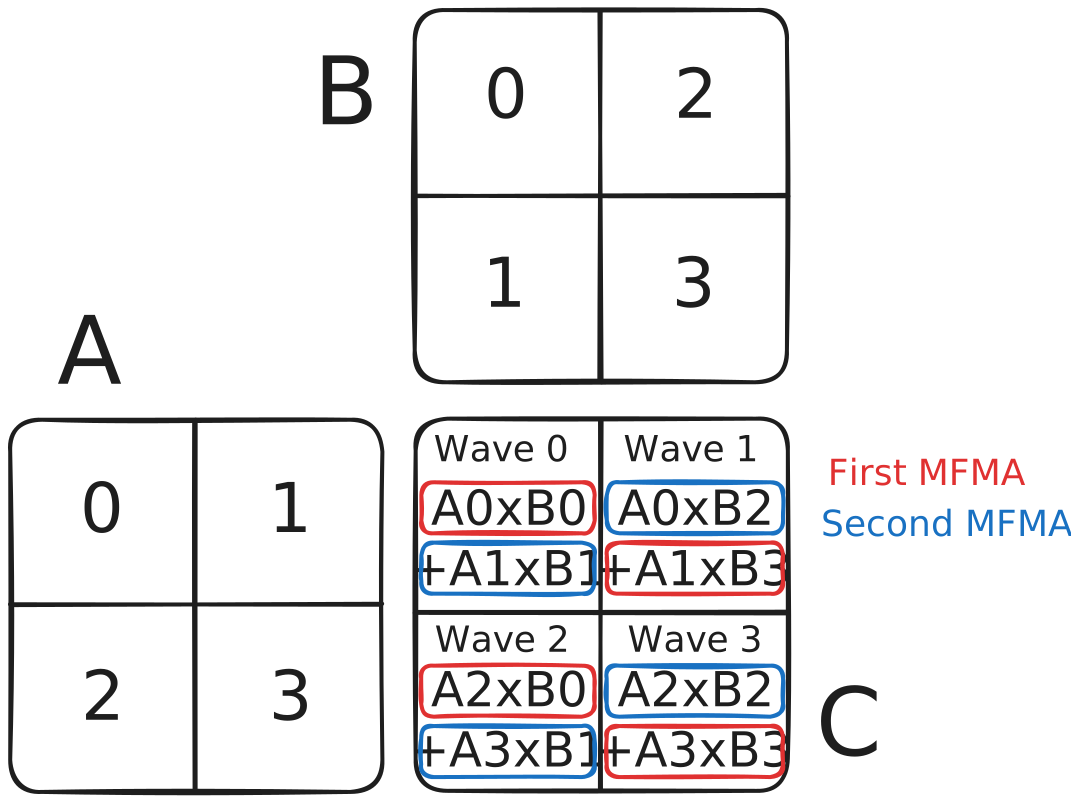
The blocked kernel launches 4 waves per block (i.e. 256 threads in
total). Just like in the previous kernel, each wave is assigned a single
output tile of C. Together, the block manages a
portion of C, which allows waves to share quantization results.
Each wave therefore does 2 MFMAs per phase instead of 1:
Figure
12: MFMAs per phase of the blocked kernel
Overall, the code is very similar to the basic version, with the
addition of extra LDS handling to share/retrieve quantized A values (no
swizzling is needed here).
If we look at the MFMA operations, we can see that each wave will use
its own quantization results at some point (i.e. wave 0 will use A0,
wave 1 will use A1, etc.), meaning we can avoid having to wait for the
associated LDS store/load and just use data that’s already in
registers.
Considering now the B-scales, we’ve seen before how they are shuffled
so that each contiguous 4 bytes contain scales for a
MFMA super-tile. In order, waves 0/2 will need scales for tiles 0/1, and
waves 1/3 scales for tiles 3/2. This reversal makes things a bit
awkward, I solved it by using the v_perm_b32 instruction,
which allows reordering bytes within a 32-bit
word.This
instruction is a carry-over from back when GPUs were actually designed
for graphics, because a common shader programming pattern is to
“swizzle” color components (in GLSL, this looks like
col.bgra for instance). The permute pattern does two
things at once: swap the 3rd and 4th values, and switch from N-major
ordering to K-major.
After that, waves will select the correct value pair, and pass the scale
to the MFMA instruction. The first MFMA uses the value at byte position
0, and the second MFMA the one at position 1, which is possible via the
opsel field.
// Read B scales for the 2x2 super-tile, permute and discardauto Bs_dat =reinterpret_cast<u32 *>(Bs_lds[prev_phase])[lid];Bs_dat =__builtin_amdgcn_perm(Bs_dat, Bs_dat,0x01030200)>>((wid &1)*16);// Other setup code...// First MFMA, use first byte of packed B-scale valueC_dat =__builtin_amdgcn_mfma_scale_f32_16x16x128_f8f6f4(...,0, Bs_dat);// Second MFMA, use second byte of packed B-scale valueC_dat =__builtin_amdgcn_mfma_scale_f32_16x16x128_f8f6f4(...,1, Bs_dat);
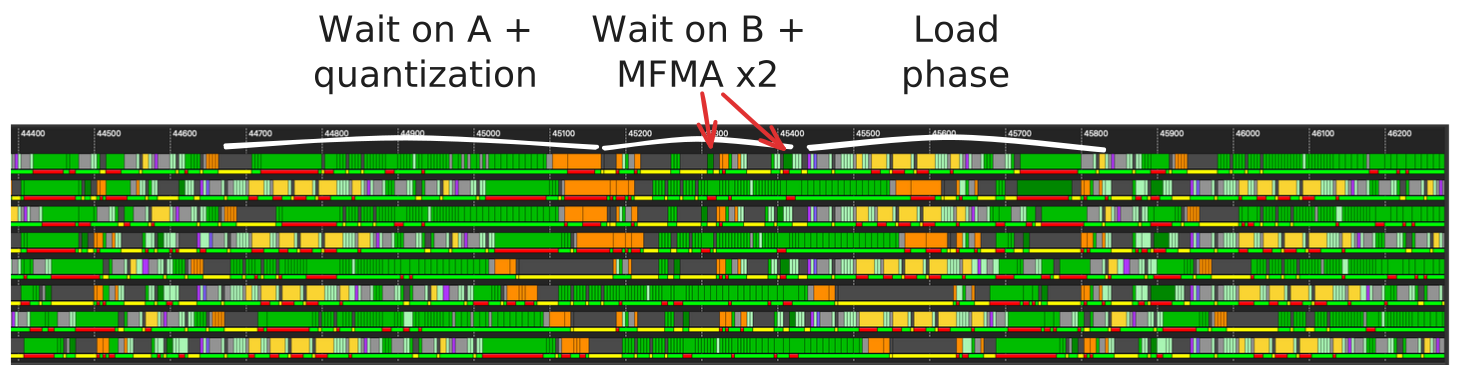
You can check the complete code for this kernel on godbolt. Hardware tracing
shows a much tighter hardware utilization, with fairly little stalling:
Figure
13: Hardware trace for the blocked kernel
Split-K kernel
variant
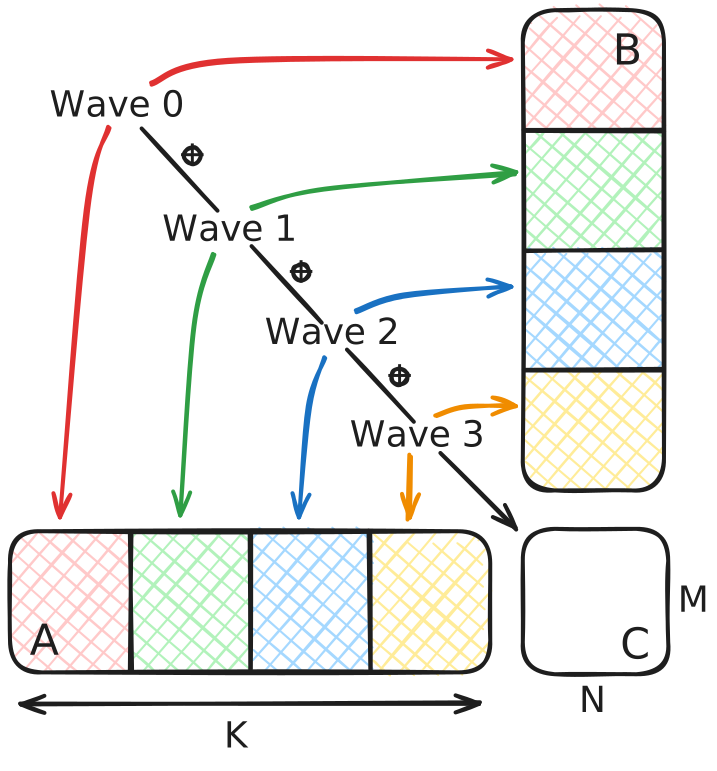
There remains a problematic input shape: M=16, N=2112, K=7168. In
this case, we don’t even have enough output tiles (132) to properly
occupy the whole GPU (256 CUs), and K is quite long (56 MFMAs), leading
to a very long accumulation loop. One way to address this is to use a
split-K method: waves process only a portion of the K dimension, and
combine their results just before output.
This sharding lets us reach much higher parallelism.
Figure
14: Split-K matmul principle
You can check the complete code for this kernel on godbolt.
Other optimizations
Kernarg preloading
At entry, the kernel must load its arguments (data pointers and
shapes). This reads from the “kernarg” segment, which is commonly
located in host
memory.This
location is chosen to avoid having to invalidate the L2 cache at kernel
boundaries, because host-mapped memory is uncached. The result is
one unavoidable, uncached load that takes about 1000 cycles, i.e. ~0.4
µs at the MI355X peak clock of 2400 MHz (see the trace below).
Figure
15: Hardware trace during kernarg loading
Instead, we can instruct the hardware to preload some of that data
into SGPRs before the CUs start executing (see here).
This is controlled by the
-mllvm=--amdgpu-kernarg-preload-count=N compiler flag
(where N is the maximum number of arguments to preload, not
the number of dwords).
Execution then begins at entry+0x100, which lets LLVM
insert a trampoline in case the hardware does not support preloading
(you can inspect this on godbolt).
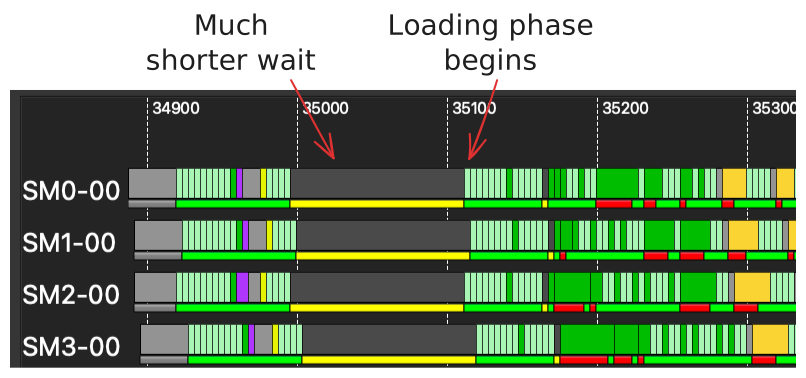
After applying this change, the waiting time is much shorter:
Figure
16: Hardware trace with kernarg preload
Why wasn’t it eliminated entirely? The reason is that the hardware
limit for preloading is 16
registers.This
is documented in the ISA manual, section 3.13 “GPR
Initialization”. That should have been enough for us, except that
the compiler also enables the kernarg segment pointer in SGPRs 0/1 for
the trampoline, effectively reducing the useful capacity to 14 dwords.
That pushes the final argument over the limit, which means we still need
a single s_load_dword.
This issue only appeared several iterations after enabling kernarg
preloading, once a few more kernel arguments had been added, so I didn’t
notice it at the time. Fortunately, it can likely be fixed with some
small argument type adjustments.
Dynamic wave
priority
When a wave switches to a loading phase, we want it to issue its load
instructions as quickly as possible to minimize latency. Since several
waves can be resident on a single SIMD core, we may run into slowdowns
if the CU decides to schedule other work first. One possible solution is
to raise the wave’s runtime priority during the loading phase, using the
s_setprio instruction. Before returning to the compute
phase, the priority is reset to its baseline value.
This didn’t produce a noticeable improvement, probably because there
wasn’t any real execution-side congestion to begin with, but I still
believe the underlying idea is sound.
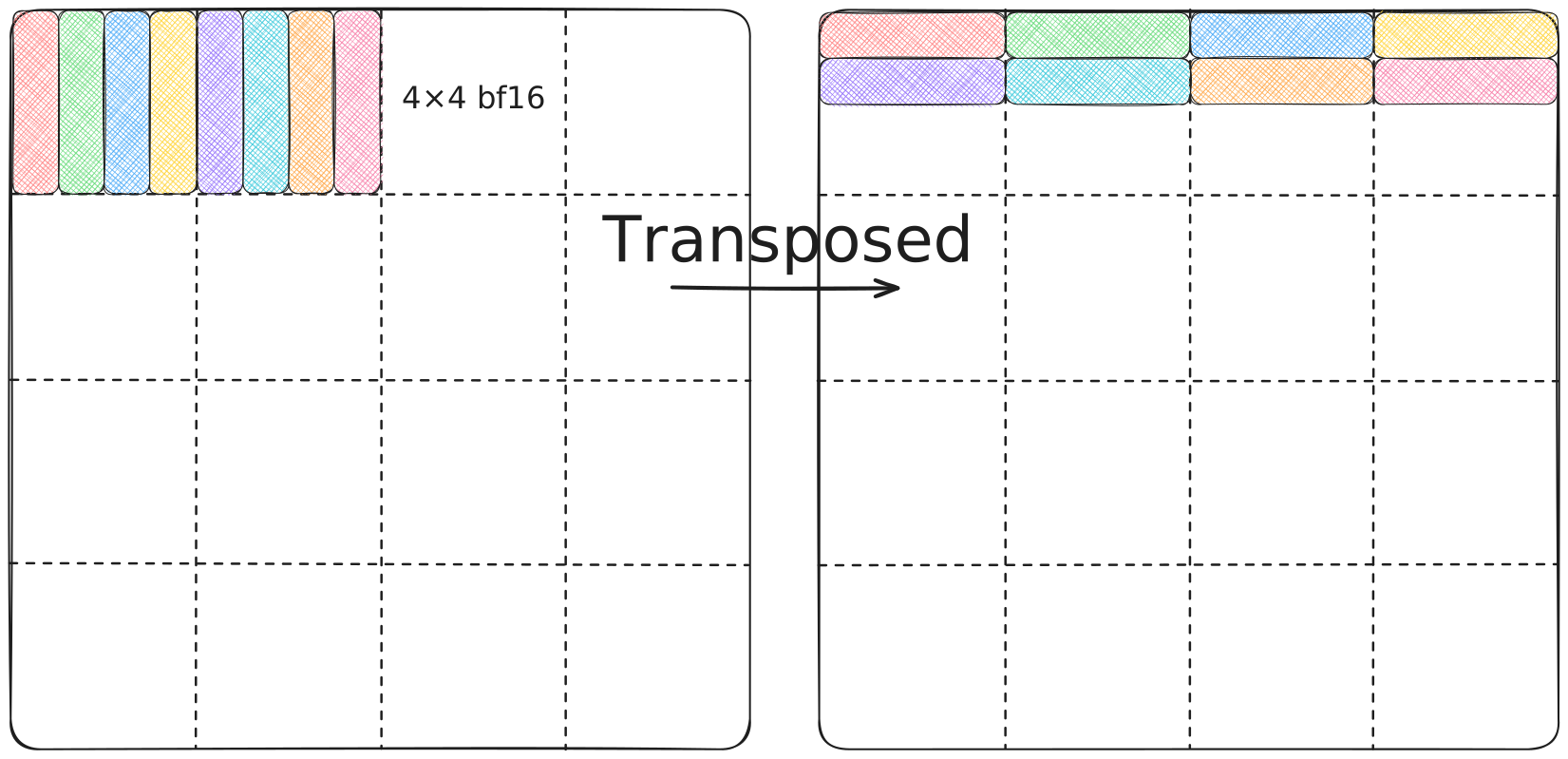
Output shuffling
The output path currently issues four separate store instructions
(each writing 2 bytes per lane) because of the matrix-core layout of the
C matrix. With LDS, we can reduce that to a single store of 8 bytes per
lane.
Since the elements of C are arranged column-major within each lane’s
registers, a naive approach would require five LDS instructions (either
one store plus four reads, or four stores plus one read) to transpose
them. However, the MI355X has a special LDS read instruction,
ds_read_b64_tr_b16, that can transpose the result of an LDS
read. The exact transpose pattern is not clearly documented, but after
some testing I found it equivalent to the following permutation for a
matrix of bf16 elements:
Or, in diagram form: Figure
17: Shuffling performed by ds_read_b64_tr_b16 on a
matrix of bf16 elements
Using this method, we can transpose C with only two LDS instructions:
one store and one read.
__shared__ bf16x4 C_lds[mxc_tile_y*mxc_tile_y/4];// Transpose the C tile to row-major using LDS// Each lane holds 4 (fp32) values of a column of C, ds_read_tr16 allows switching to row-major.// With some shuffling on top of that, we can issue a single global_store_dwordx2 instead of 4,// which will be coalesced in the TA unit regardless of the shuffling.// ds_read_tr16 requires all lanes to be active, so do the shuffling outside of the if-guard.auto shfl =((lid &3)<<2)+((lid >>2)&3)+(lid &~15);C_lds[shfl]= bf16x4{static_cast<bf16>(C_dat[0]),static_cast<bf16>(C_dat[1]),static_cast<bf16>(C_dat[2]),static_cast<bf16>(C_dat[3]),};// No barrier needed here since we have only one wave executingauto res =__builtin_amdgcn_ds_read_tr16_b64_v4bf16((__attribute__((address_space(3))) bf16x4 *)C_lds + lid);// Write the C tile into global memory using a nontemporal store,// to avoid evicting useful data from the caches.if(C_y +(lid >>4)*4< m){__builtin_nontemporal_store(res,reinterpret_cast<bf16x4 *>(C_ptr +(C_y +(shfl >>2))* n + C_x +((shfl &3)<<2)));}
Unfortunately, this does not produce a noticeable improvement in
kernel runtime. The original idea was to use it in the blocked kernel,
since it would allow stores for horizontally adjacent tile pairs to be
coalesced and could potentially speed up the epilogue. On AMD GPUs,
kernels terminate by issuing the s_endpgm instruction,
which implies waiting for all outstanding memory operations to complete
(see the trace below). By reducing the number of in-flight store
requests, we could potentially shave off some of that latency.
However, I ran out of time to implement this change.
Figure
18: Execution tail due to waiting on stores to
complete
What was missing?
In this section, I compare my work with the winning contest entries,
and go over possible improvements that could’ve been implemented.
Host-side
optimizations
All the winning entries I’ve checked used some flavor of host-side
caching to avoid allocating fresh output buffers for C on every
benchmark iteration, and to ask PyTorch for memory-contiguous instances
of the buffers for A and B (which should be a no-op).
I initially dismissed the idea since the benchmarking code uses
GPU-side events to measure kernel runtime. However, it turns out that a
~4 us overhead was introduced in basically every measurement. So it’s
possible that the Python code is so slow that the first event gets
recorded before the kernel is even submitted, hence the need for a fast
host codepath.
Tighter memory
loading
Loading everything upfront
Something I failed to account for is that the K dimension is very
small for certain input shapes: with K=512, we just have 4 MFMAs before
we’ve processed an entire tile.
In such a situation, our double buffering process using LDS is
actually suboptimal, because we have a serial dependency on loading
phases: we don’t issue loads for later tiles until we’ve received the
previous ones. Instead, it would be better to just load everything
upfront into registers.
One of the winning entries uses this strategy for the M=4, N=2880, K=512
shape, and I suspect it could be adapted for the other K=512 cases.
Triple buffering
In GPU code, memory accesses are tricky to get right, and this
contest is no exception. Despite the double buffering we implemented, we
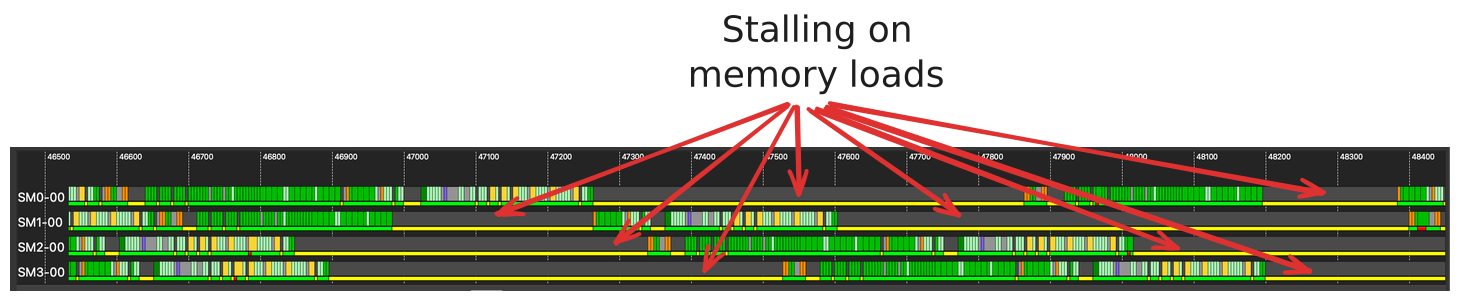
still have stalls due to memory latency. Take for example this trace of
the split-K kernel: Figure
19: Hardware trace of split-K kernel, showing stalls
One possible way to improve this situation would’ve been to implement
triple buffering (or more, but triple seems like it would’ve been
sufficient). The MI355X has a pretty large shared memory capacity (160
KiB),Also,
AMD’s implementation of shared memory is a dedicated block of very fast
memory, so not using it entirely is essentially wasting resources. This
is unlike NVIDIA, where SMEM is partitioned out of the L1 cache, and
thus a larger shared memory usage can be detrimental due to increased
cache pressure. LDS on AMD cards is also much faster than on NVIDIA (see
bandwidth benchmark here,
and keep in mind the MI355X doubles the LDS bandwidth compared to the
MI300X!) not taking full advantage of it was a mistake.
(Over-)specialization
The winning entries had much finer-grained specialization for the
input shapes. In my case, I just had three approaches: basic, split-K
(used once each), and blocked (used for the other shapes). Further
specialization would’ve allowed removing some inefficiencies in certain
cases, such as the double buffering we mentioned above.
Below is a fragment from the best entry, showing how it dynamically
routes to specialized kernels for every single input
shape!If
you’re wondering why the code is that bad, it’s because it was entirely
vibe-coded, and its “author” has no idea how it works, by his own
admission.
def _get_route(m, n, k): key = (m, n, k)if key in _FUSED_CONFIGS:return ("fused", _FUSED_CONFIGS[key])if key in _ASM_CONFIGS:return ("asm", _ASM_CONFIGS[key]) pair = (n, k)if pair == (2112, 7168):if m <16:return ("fused", _FUSED_K7168_KSPLIT14)return ("fused", _FUSED_CONFIGS[(16, 2112, 7168)])if pair == (3072, 1536):if m <=16:return ("fused", _FUSED_K1536_SPLIT)return ("fused", _FUSED_K1536_NOSPLIT)if pair == (2880, 512):if m <16:return ("fused", _FUSED_CONFIGS[(4, 2880, 512)])if m <128:return ("fused", _FUSED_CONFIGS[(32, 2880, 512)])return ("fused", _FUSED_BM32_K512)if pair == (4096, 512):return ("fused", _FUSED_CONFIGS[(32, 4096, 512)])if pair == (7168, 2048):return ("fused", _FUSED_K2048_NOSPLIT)returnNone
Conclusion
This was my first time dealing with micro-scaled formats and
programming matrix cores. I learned a lot from this experience despite
the less-than-ideal working conditions (no direct machine access for
debugging, runners constantly being spammed by people using agents). In
particular, I’m quite proud of the tricks I came up with for the
quantization code.
A big thanks to the GPU MODE and AMD organizers for hosting this
event.
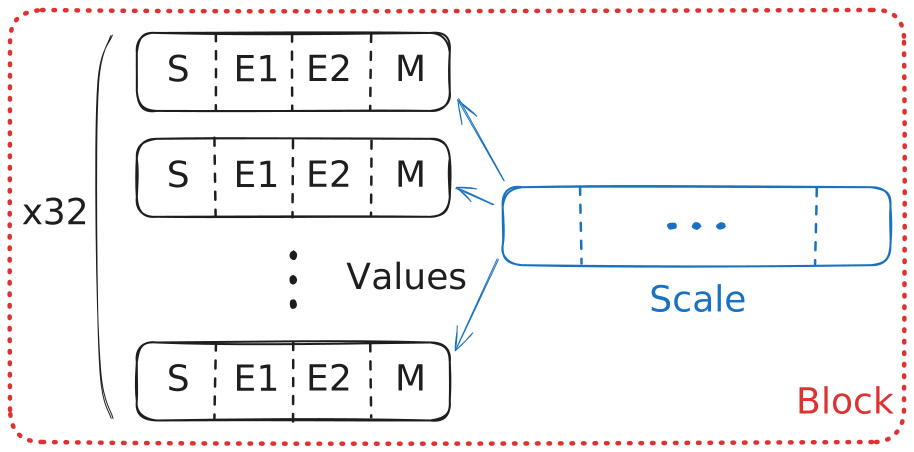 Figure
1: The mxfp4 floating-point format
Figure
1: The mxfp4 floating-point format